Architecture
Digital Assets API
Define a canonical contract across providers, clients, and operating teams.
Explore guideArchitecture and integration guidance for market data, blockchain, RWA tokenization, trading and perps, compliance, tax reporting, Django, WordPress, iOS, Android, dapps, charting, and AI applications.
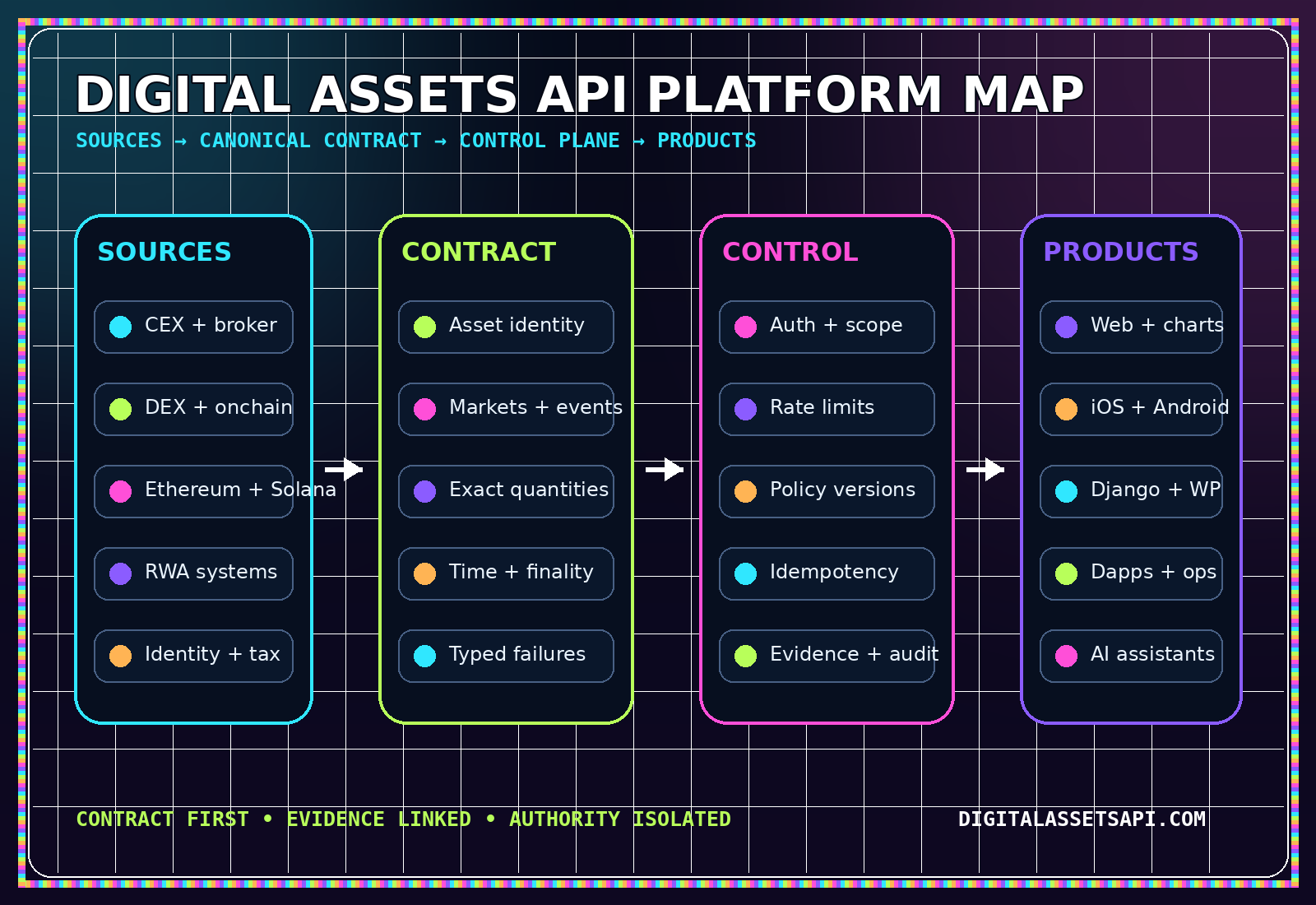
“Digital Assets API” can mean a feed, node interface, private account connection, execution surface, tokenization platform, or reporting workflow. Choose the operating problem first.
Define a canonical contract across providers, clients, and operating teams.
Explore guideNormalize CEX, DEX, broker, order-book, trade, candle, and chart data.
Explore guideIndex Ethereum, Solana, transactions, logs, instructions, accounts, and balances.
Explore guideConnect assets, eligibility, issuance, servicing, settlement, and reconciliation.
Explore guideModel orders, fills, positions, funding, margin, risk controls, and latency tiers.
Explore guideBuild evidence-based policy workflows and reproducible digital asset ledgers.
Explore guideA stable product boundary absorbs changing provider schemas while keeping source evidence, authority, and quality visible.
Exchange and broker APIs, Ethereum and Solana RPC, DEX events, identity providers, tax records, and tokenization systems.
Canonical assets, networks, markets, accounts, transactions, quantities, timestamps, and typed errors.
Permissions, rate limits, finality, policy versions, idempotency, signing boundaries, evidence, and reconciliation.
Web, TradingView-style charts, Django, WordPress, iOS, Android, dapps, operations dashboards, and AI assistants.
These names describe integration and search intent, not partnerships or endorsements. Verify official access, terms, product scope, and regional availability.
Latency is only one dimension. Many failures begin with missing history, ambiguous identity, stale state, or unrecoverable writes.
| Use case | Optimize first | Prove in testing | Do not hide |
|---|---|---|---|
| Portfolio app | Identity and freshness | Offline recovery and balance reconciliation | Stale values and unsupported assets |
| Charting | Ordered events | Snapshot + stream gap recovery | Price methodology |
| Trading | Idempotency and state | Unknown outcomes and reconnects | Mark/index/last differences |
| RWA | Lifecycle evidence | Failed issuance and partial redemption | Off-chain authority |
| Compliance | Policy reproducibility | Async cases and provider outages | Uncertainty and review |
| Tax | Completeness | Pagination, transfers, lots, reconciliation | Missing basis and prices |

A contract-first framework for scoping, normalizing, securing, and operating a digital assets API across market data, blockchain data, trading, and compliance workloads.
Read article
A systems guide to APIs for real-world asset issuance, eligibility, servicing, valuation, reserves, settlement, and onchain evidence.
Read article
A server-side Django architecture for digital asset provider clients, secrets, retries, caching, webhooks, tasks, models, tests, and observability.
Read articleDigitalAssetsAPI.com is an independent educational resource. The site explains how teams can evaluate and design integrations without fabricating live endpoints, customer claims, credentials, partnerships, or performance statistics.
About this publicationEvery guide emphasizes canonical identifiers, explicit time and finality, exact quantities, typed failure states, server-side secrets, idempotent writes, source evidence, and honest uncertainty.
It is an application interface for digital asset data or operations, such as market data, blockchain activity, private accounts, trading, tokenization, compliance, or tax reporting. Production systems usually combine several interfaces behind one canonical application contract.
No. DigitalAssetsAPI.com is an independent educational publication. It provides architecture guides, integration patterns, and evaluation checklists; it does not operate an exchange, brokerage, wallet, tax service, or API endpoint.
A gateway can normalize selected concepts across those ecosystems, but coverage, permissions, schemas, data rights, and regional availability differ. Preserve source-specific fields and verify every integration in official documentation.
Long-lived provider secrets, account permissions, canonical identity, exact calculations, write authority, policy checks, and audit evidence should stay on the server. Mobile clients receive scoped, user-authorized application data.
AI can summarize structured facts, explain anomalies, and assist review. It should not invent missing prices, authorize trades or transfers, establish legal compliance, or replace deterministic tax calculations.
No. HFT requires specialized infrastructure, protocols, deterministic performance, and microstructure controls. A general cloud API may support monitoring or lower-frequency execution without meeting HFT requirements.
Define the consumer, authority, freshness, completeness, history, privacy, failure behavior, and evidence before comparing endpoint catalogs.